REPORT SPEECH

What is «Report Speech»?

This grammar is used when the speaker want to say something that another person has said.

Esta gramática se usa cuando un hablante quiere decir algo que otra persona ha dicho.

This in an indirect speech that comes from a direct speech and must be change in the grammar time.

Este estilo indirecto proviene de un estilo directo a la hora de hablar y que requiere un cambio de tiempo gramatical a la hora de usarlo.

Present simple ⇨ Past Simple

My mother told me: «I get up at 5 oclock everyday»

My mother told me that she got up at 5 oclock every day.

Present Continuous ⇨ Past Continuous

The dirver said to me: «This driver is driving on the wrong side»

The driver said to me that that driver was driving on the wrong side.

Past Simple ⇨ Past Perfect

The victim said: «The robber came into my house while I was in.»

The victim said that the robber has come into the house while he was in.

Present Perfect ⇨ Past Perfect

My son has come running to me and told me: «I’ve swallowed my chewing gum»

My son has come runing to me and he told me that he had swallowed his chering gum.

Present Perfect continuous ⇨ Past Perfect continuous

Your mother told me: «Your friend Marisa has been waiting for you around two hours, but she left since you weren’t here»

Your mother told me that my friend Marisa had been waiting for me around two hours, but she left since I wasn’t there.

Will ⇨ Would

Her brother told me: «I will go and see your new house.»

Her brother told me that he would go and see my new house.

Past perfect and past perfect continuous cannot be changed so it is left as it is.

EL past simple and past perfect continuous no se cambia en ningún caso y se deja como está el verbo.

The modal verbs have the same way to be done, we need to used the past form of them.

Can ⇨ Could

Shall ⇨ Should

Will ⇨ Would

must ⇨ have to

have to ⇨ had to

Need ⇨ Needed

Adverbios de tiempo
Estilo directo o Direct Speech
Adverbios de tiempo
Estilo indirecto o Reported Speech
Today / TonightThat day / That night
This day / week / month / yearThat day / week / month / year
TomorrowThe next day
Next day / week / month / yearThe following day / week / month / year
YesterdayThe previous day / The day before
Last week / month / yearThe previous week / month / year or the previous week / month/year
NowAt that moment / then
HereThere

Créditos de las fotos en las fotos, explicación redactada por la página.

Write an Article

Escribir un artículo es parte muy importante del writing tanto en nivel B1 como B2. No siguen características muy diferentes, pero en este articulo las definiremos según los niveles.

An article can be read in magazines, newspappers and even in blogs, they gives us information, guides and opinions on specific topics, and it’s main objetive is to take the reader attetion until the end of it.

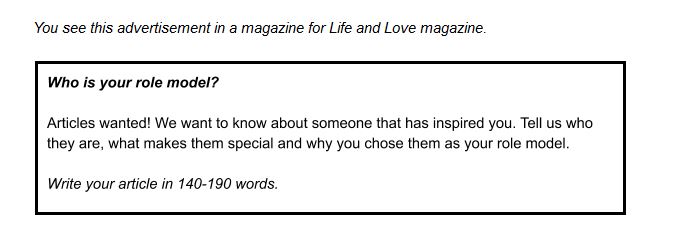
Now I am going to explain how to create an article from an example:

How to write an article - Cambridge B2 First | Oxford House Barcelona

The structure

Paragraph 1: Introduction: Start with a catchy opening line to hook the readers.

There is not one who could be as an amazing person as/such as my grandfather and granny. Their strong personality and vitality have marked me for my life, because they are the person who have been next to me all my life.

Paragraph 2: Describe the topic giving examples and developing your answer.

For a start I will tell you how was their teen ages. The used to lived in a small village in the middle of the mountaint in Ronda, they went to school, where they learnt how to write and read and basic things for their dailylife. My grandfather remembered those times with so much love, he always told us that his best friend at that time was a goat, which always went with him to school and he always tell us how their school mates usually played with it on the playgound. My granny used to go to school too but she also was taught how to sew and cook since she was a girl, that’s why he is the best cooker, I love her food. She also used to work in her family’s backery at that time. Bouth of them were the youngest one in the family so they were very spoyled.

When the grow up, my grandparents got merry, that’s when they moved to Ronda city, while my granny was pregnat with my father. They lived there for a few moth before moved to Algeciras with some of their simblids and my grandfather’s mother.

After they moved to Algeciras my father had another two siblinds, and my grandfather opened in the market an inlay shop. In a start all the family was living together but while time past, they moved to another house, until my grandfather bought a house on a flat in the city center. I am the first great-doughter in the family so I have spent do much time with them. Every weeken I used to go to mass on Saturday and we visited their other relatives, who lived near an ice cream shop and in summer I always had one each tiem we went to see them. Also, I used to cook with my granny or even sew. It was very funny and unforgatefull.

Paragraph 3: This should be like a conclusion and give the reader a lasting comment or a question to think about.

On top of that they are my modal rolle since they have been taking care of all the family all this time. Since they are the youngest in the family they have seen eveyone died, they have taken care of all those who were left alone. When I have been on my worst they have always been there, but not only for me, just for everyone who needed them. They are the strongest people that I know, and now a days they are having a really hard time because of the covi-19 situation since they cannot see the family as much as they would like too. They have lived so much and have tought me how to afort all those hard times. They have given me a life lesson.

Who is your life lesson? in which way have him/her/it influenced you?

For to divided those paragraph you can divede them using diferent connectors like:

First paragraph: For a start…

Second paragraph: Not to mention…

Third paragraph: On top of that…

These ones are examples but you can use whatever you want or you are used to use.

Tips

Think about the question.

It could be a family member that you look up to or a person in the community who’s done something amazing.

Think about the tone.

They are between semi-formal and informal tone. They are informative and entertaining.

Think about what is the best structure.

Even I have given you a basic structure it can be different depending on the topic or what you want to express, but always have on mind that it must be logical, coherent and msut include different ideas in different paragraphs.

Think about the vocabulary.

You can d a braindstorming wiht ideas and vocabulary that can help you to be more creative.

Personalise your writing.

You can give to your writing a personal style like adressing the reader with pronouns like «you, I»

Have you ever wondered…?

I’m sure you can imagine…

Can you believe…?

I will never forget…

There’s nothing more amazing than…

If you ask me…

B1 Evaluation 2020:

at least 100 words

You included everything in the question

You’ve used a variety of sentence lengths

Correct Present, Past, Perfect, Future and Modal verbs use; superlatives and comparatives, gerund, conditionals, passive voice en present, past and perfect, relatives, correct adjetives, etc.

The spelling is correct

It’s personal and engaging

You haven’t repeated the same vocabulary too often

It’s not too formal

B2 Evaluation 2020:

Between 140 to 190 words

You included everything in the question

You’ve used a variety of sentence lengths

Correct Present, Past, Perfect, Future and Modal verbs use; superlatives and comparatives, gerund, conditionals, passive voice en present, past and perfect, modal causative, relatives, correct adjetives, etc.

The spelling is correct

It’s personal and engaging

You haven’t repeated the same vocabulary too often

It’s not too formal

Credits: https://oxfordhousebcn.com/

Write an email

Escribir un e-mail es parte muy importante del writing tanto en nivel B1 como B2. NO siguen características muy diferentes, pero en este articulo las definiremos según los niveles.

An email should be divided aroung three paragraphs with a greeting and end it wict a close sentence and your name. Remember that each part should be divided between paragraphs with a full stop (punto y a parte) and that each idea must be divided in each paragraph. You must start with capital letter.

EMAIL STRUCTURE:

From: Larry.

To: John.

  • Greetings: we greet the other person (i.e. say «hi» or «hello»).
    • Hi John, 
    • Hello John,
    • Dear John,
  • Opening paragraph: we react to the other person’s news and ask them how they are feeling and whatever else you feel is appropriate.
    • It’s nice / great / good to hear from you. 
    • It’s nice / great / good  to read your email. 
    • I’m glad to hear your news. 
    • I’m excited about…  (your news.)
    • It’s great to hear that
    • I’m sorry to hear that…
    • I’m really sorry to read your news. 
    • Thanks a lot for writing!
    • It was good to receive your email
    • Thank you very much for your email. 
    • Hope you are doing well. 
    • How’s it going? 
    • How are you (doing)?
    • How are things (going)?
  • Main paragraph 1: in this paragraph we deal with the first important point, which we can identify in the instructions.
  • Main paragraph 2: if there is a different point to deal with, this paragraph will do so.
    • and
    • but
    • However
    • Moreover
    • because
    • because of that
    • as for
    • regarding
  • (We might have more main paragraphs, depending on the task.)
  • Closing paragraph: in this paragraph we «start» to say goodbye by wishing the other person well and asking them to reply to your email.
    • Well, it’s time to say goodbye. 
    • Anyway, I have to go now. 
    • Well, it’s time to go. 
    • Anyway, gotta go. 
    • I really hope to hear from you soon. 
    • I’m looking forward to hearing from you. 
    • I hope you write back soon. 
    • Make sure you write back soon. 
  • Goodbye: we use a short expression to say goodbye.
    • Best wishes,
    • Best,
    • Sincerely, 
    • Take care, 
    • All my love, 
    • Love,
    • Lots of love, 
    • See you soon
    • Regards
    • Best regards
  • Signature: we sign the email with our name.

Remember taht you should always include all the tips that are int the activity description.

The tone is coloquial so you can use coloquial expressions and contract words as don’t, didn’t, can’t, etc.

B1 Evaluation 2020:

at least 100 words

the text is clear

use correct expressions

connectors

questions

all notes are included in the text

Grammar sentences such as:

Correct Present, Past, Perfect, Future and Modal verbs use; superlatives and comparatives, gerund, conditionals, passive voice en present, past and perfect, relatives, correct adjetives, etc.

B2 Evaluation 2020:

Between 140 to 190 words

supportive opinion

clear text

difficult vocabulary

questions

organised and coherent

Correct Present, Past, Perfect, Future and Modal verbs use; superlatives and comparatives, gerund, conditionals, passive voice en present, past and perfect, modal causative, relatives, correct adjetives, etc.

Credits to https://kseacademy.com

PERFECT TIME

PRESENT PERFECT SIMPLE

Subject + have / has + -ed / 3rd colum irregular verbs + cc…

  • Past action which has been done recently or have conseceunces in present

PRESENT PERFECT CONTINUOUS

Subject + have / has + been + verb -ing + cc…

  • long action which started in the past and contiuous in the present time

PAST PERFECT SIMPLE

Subject + had + -ed / 3rd colum irregular verbs + cc…

  • an action that tool place in the past

PAST PERFECT CONTINUOUS

Subject + had + been + verb -ing + cc…

  • a long action which was done in the past and it was continuous

FUTURE PERFECT SIMPLE

Subject + will / won’t + have + 3dr colum irregular verbs + cc…

  • an action which will finish in the future but was done in the past

ADVERBS:

ever / never / recently / just / yet / for / since / before / after / by the time / when

ACTIVITIES

https://agendaweb.org/verbs/present-perfect-worksheets-lessons

https://www.e-grammar.org/present-perfect-simple-continuous/

Los links aquí subidos pertenecen a sus propietarios y no a este blog, el blog solamente se encarga de poder facilitárselo a sus alumnos y seguidores.

Future

FUTURE SIMPLE

Subject + will / will not / won’t + infinitive verb + cc…

  • Something which is think to be happened
  • desition made at the moment
  • a near future

You will use the verbs:

Think / believe / know / doubt / suppose / hope / assume / expect

Adverbs:

this evening… / next week / soon / in a few… / in March / in the future / tomorrow

BE GOING TO

Subject + is/ are/ am + going to + infinitive verb + cc…

  • Somenthing which is planed and will be done in the future
  • what is going to happen at the moment to speack

Adverbs:

This evening / later / next…/ soon / at…. oclock / in a hour / tonight / tomorrow

FUTURE CONTINUOUS

Subject + will / won’t + be + infinitive verb -ing + cc…

  • Somenthing which is ahappening in the future

Adverbs:

at this time tomorrow / at this time next year / at this time on Thursday

Activities:

https://agendaweb.org/verbs/future-worksheets-lessons-exercises

https://www.e-grammar.org/future-simple-continuous/

Los links aquí subidos pertenecen a sus propietarios y no a este blog, el blog solamente se encarga de poder facilitárselo a sus alumnos y seguidores.

How to write an essay

You need to write your opinion about a topic, situation or issue from different points of view.

The purpose of this writing is to analyse and assess a topic, a situation or an issue, them will be controversial or interesting. It can be done after class debate.

You need to provide different arguments and express your opinion.

Write a title for the essay.

An essay is writing in a formal style, so we need to use an objetive tone and style about the topic.

Formal language, so you need to avoid common words or generic words and contractions like can’t, don’t, etc.

The body of the text should be divided into around 5 paragraphs:

  • Introduction
  • Idea 1
  • Idea 2
  • Idea 3
  • Conclusion.

The opinion should be the last paragraph as a conclusion, and you beed to justify everything in your essay.

Is essential in an essay coherence with the ideas and argumet, you need to follow a logical order and divide all the information by paragraph.

It is very important to use appropriate linkers to conect one paragraph to the next one and following the previous one.

You have to write 140-190 words.

Remember not to repeat more than two times the sames words, less you cannot use anyother word. Remember use sinonym.

How to start:

You have to write an essay, so this is the first thing you should learn to write. Essays are about giving information and your opinions, comparing and contrasting.

Title: Use a title at the top of your essay. The title should be interesting so that someone would want to read the article. Imagine two friends share a link on Facebook. Which are you more likely to click on?

Topic: Why Pollution is Bad

Paragraph:

  • Title: Climate Change is Fake, and Here’s Why
  • Body:
  • Introduction the topic
  • The Transport Pollution Problem
  • Pollution in Rivers and Seas
  • Pollution at Home
  • Conclusion. What I think about the topic and what I do take as most important about it.

Example from https://www.fceexamtips.com/writing#8._FCE_Essays

wh… questions

English

To make a question it’s need to used always a pattern:

Wh… + auxiliar (do/does/did/have/has/had) + subject + verb + adverbs + adjetives + nouns + etc…?

Español

Para hacer una pregunta en ingles siempre seguiremos un mismo patrón:

Wh… + auxiliar (do/does/did/have/has/had) + subject + verb + adverbs + adjetives + nouns + etc…?

When – Cuándo

Where – Dónde

Why – Por qué

How – Cómo

Who – Quién

What – Qué

Which – Qué

whose – De quién

How much – Cuanto

How many – Cuanto

Now you will do some activities by pdf with answerd and web activities.

enseñaringlesencasa.com

grammarnet.com

grammarbank.com

agendaweb.org

Los links aquí subidos pertenecen a sus propietarios y no a este blog, el blog solamente se encarga de poder facilitárselo a sus alumnos y seguidores.

Irregular verb list

InfinitivePast SimplePast ParticipleSignificado
arisearosearisensurgir
bewas / werebeenser
beatbeatbeatengolpear
becomebecamebecomeconvertirse
beginbeganbeguncomenzar
betbet/bettedbet/bettedapostar
bitebitbittenmorder
bleedbledbledsangrar
blowblewblownsoplar
breakbrokebrokenromper
bringbroughtbroughttraer
buildbuiltbuiltconstruir
buyboughtboughtcomprar
catchcaughtcaughtatrapar
choosechosechosenelegir
comecamecomevenir
costcostcostcostar
creepcreptcreptarrastrarse
cutcutcutcortar
dealdealtdealtdar, repartir
dodiddonehacer
drawdrewdrawndibujar
dreamdreamt/dreameddreamt/dreamedsoñar
drinkdrankdrunkbeber
drivedrovedrivenconducir
eatateeatencomer
fallfellfallencaer
feedfedfedalimentar
feelfeltfeltsentir
fightfoughtfoughtpelear
findfoundfoundencontrar
fleefledfledhuir
flyflewflownvolar
forgetforgotforgottenolvidar
forgiveforgaveforgivenperdonar
forsakeforsookforsakenabandonar
freezefrozefrozencongelar
getgotgottener, obtener
givegavegivendar
gowentgoneir
grindgroundgroundmoler
growgrewgrowncrecer
hanghunghungcolgar
havehadhadtener
hearheardheardoír
hidehidhiddenesconderse
hithithitgolpear
holdheldheldtener, mantener
hurthurthurtherir, doler
keepkeptkeptguardar
kneelkneltkneltarrodillarse
knowknewknownsaber
leadledledencabezar
learnlearnt/learnedlearnt/learnedaprender
leaveleftleftdejar
lendlentlentprestar
letletletdejar
lielaylainyacer
loselostlostperder
makemademadehacer
meanmeantmeantsignificar
meetmetmetconocer, encontrar
paypaidpaidpagar
putputputponer
quitquit/quittedquit/quittedabandonar
readreadreadleer
rideroderiddenmontar, ir
ringrangrungllamar por teléfono
riseroserisenelevar
runranruncorrer
saysaidsaiddecir
seesawseenver
sellsoldsoldvender
sendsentsentenviar
setsetsetfijar
sewsewedsewn/sewedcoser
shakeshookshakensacudir
shineshoneshonebrillar
shootshotshotdisparar
showshowedshown/showedmostrar
shrinkshrank/shrunkshrunkencoger
shutshutshutcerrar
singsangsungcantar
sinksanksunkhundir
sitsatsatsentarse
sleepsleptsleptdormir
slideslidsliddeslizar
sowsowedsown/sowedsembrar
speakspokespokenhablar
spellspelt/spelledspelt/spelleddeletrear
spendspentspentgastar
spillspilt/spilledspilt/spilledderramar
splitsplitsplitpartir
spoilspoilt/spoiledspoilt/spoiledestropear
spreadspreadspreadextenderse
standstoodstoodestar de pie
stealstolestolenrobar
stingstungstungpicar
stinkstank/stunkstunkapestar
strikestruckstruckgolpear
swearsworeswornjurar
sweepsweptsweptbarrer
swimswamswumnadar
taketooktakentomar
teachtaughttaughtenseñar
teartoretornromper
telltoldtolddecir
thinkthoughtthoughtpensar
throwthrewthrownlanzar
treadtrodetrodden/trodpisar
understandunderstoodunderstoodentender
wakewokewokendespertarse
wearworewornllevar puesto
weavewovewoventejer
weepweptweptllorar
winwonwonganar
wringwrungwrungretorcer
writewrotewrittenescribir

Past Simple

ENGLISH:

The past simple is as in spanish Pretérito Indefinido.

We use it when we speak about actions that happened in a recent past like a had dinner, showered, went to sleep, …

Actions that happened after another action in an expecific period of time in the past.

ESPAÑOL:

El Past Simple en español hace referencia al tiempo verbal indicativo de Pretérito Indefinido.

Este tiempo define lo que hemos hecho en un pasado reciente y en un momento concreto.

También se usa cuando una acción del pasado sucede antes que otra en un periodo del pasado.

Grammar explanation / Explicación

• Afirmative / Afirmación

English:

All personal pronoun include the same structure at the root of the verb.

The main difference in the past is that we can find irregular verb that include at the end of the root of the verb -ED and regular verb that will have a different structure or composition.

Español:

Todos los pronombres personales se forman con la misma estructura de la raíz del verbo.

La principal diferencia en este tiempo verbal la encontramos cuando tenemos verbos que son irregulares y que no cabían la raíz del verbo y se le incluye simplemente -ED a esta, y luego están los verbos regulares que poseen una forma o estructura propia.

Irregular verb:

I played
You played
He, She, It played
We played
You played
They played

Regular verb:

I slept
You slept
He, She, It slept
We slept
You slept
They slept

• Negative / Negación

ENGLISH:

The negative sentences have always the same structure, we use «did + not = didn’t» before the verb root.

The verb must be as its root.

Español:

Las frases en negativo en ingles siempre se forman con la misma estructura, usamos «did + not = didn’t» antes de la raíz del verbo.

El verbo siempre debe de aparecer como en infinitivo o su raíz.

Irregular Verb:

I didn't play
You didn't play
He, she it didn't play
We didn't play
You didn't play
They didn't play

Regular Verb:

I didn't sleep
You didn't sleep
He, she it didn't sleep
We didn't sleep
You didn't sleep
They didn't sleep

• INTERROGATIVE / PREGUNTA

ENGLISH

When we make a question we need to use the auxiliar verb «did» before the personal pronoum and the verb.

ESPAÑOL

Para hacer una pregunta usaremos el verbo auxiliar «do, does» antes del pronombre personal y el verbo.

Regular Verb:

Did I sleep?
Did you sleep?
Did he, she, it sleep?
Did we sleep?
Did you sleep?
Did they sleep?

Irregular Verb:

Did I play?
Did you play?
Did he, she, it play?
Did we play?
Did you play?
Did they play?

Time Adverb / Adverbios de tiempo

Yesterday
Two days ago
a year ago
last...
when
ever
in 1995

Adverbs will help you to remember which gramar time to use because most of the time those adverbs are use only on that time. 

No olvides que los adverbios de tiempo nos ayudan a saber que tiempo verbal debemos usar ya que muchos de ellos solo pueden ir en ese tiempo verbal.

Carmen Melgar Marcos

InfinitivePast SimplePast ParticipleSignificado
arisearosearisensurgir
bewas / werebeenser
beatbeatbeatengolpear
becomebecamebecomeconvertirse
beginbeganbeguncomenzar
betbet/bettedbet/bettedapostar
bitebitbittenmorder
bleedbledbledsangrar
blowblewblownsoplar
breakbrokebrokenromper
bringbroughtbroughttraer
buildbuiltbuiltconstruir
buyboughtboughtcomprar
catchcaughtcaughtatrapar
choosechosechosenelegir
comecamecomevenir
costcostcostcostar
creepcreptcreptarrastrarse
cutcutcutcortar
dealdealtdealtdar, repartir
dodiddonehacer
drawdrewdrawndibujar
dreamdreamt/dreameddreamt/dreamedsoñar
drinkdrankdrunkbeber
drivedrovedrivenconducir
eatateeatencomer
fallfellfallencaer
feedfedfedalimentar
feelfeltfeltsentir
fightfoughtfoughtpelear
findfoundfoundencontrar
fleefledfledhuir
flyflewflownvolar
forgetforgotforgottenolvidar
forgiveforgaveforgivenperdonar
forsakeforsookforsakenabandonar
freezefrozefrozencongelar
getgotgottener, obtener
givegavegivendar
gowentgoneir
grindgroundgroundmoler
growgrewgrowncrecer
hanghunghungcolgar
havehadhadtener
hearheardheardoír
hidehidhiddenesconderse
hithithitgolpear
holdheldheldtener, mantener
hurthurthurtherir, doler
keepkeptkeptguardar
kneelkneltkneltarrodillarse
knowknewknownsaber
leadledledencabezar
learnlearnt/learnedlearnt/learnedaprender
leaveleftleftdejar
lendlentlentprestar
letletletdejar
lielaylainyacer
loselostlostperder
makemademadehacer
meanmeantmeantsignificar
meetmetmetconocer, encontrar
paypaidpaidpagar
putputputponer
quitquit/quittedquit/quittedabandonar
readreadreadleer
rideroderiddenmontar, ir
ringrangrungllamar por teléfono
riseroserisenelevar
runranruncorrer
saysaidsaiddecir
seesawseenver
sellsoldsoldvender
sendsentsentenviar
setsetsetfijar
sewsewedsewn/sewedcoser
shakeshookshakensacudir
shineshoneshonebrillar
shootshotshotdisparar
showshowedshown/showedmostrar
shrinkshrank/shrunkshrunkencoger
shutshutshutcerrar
singsangsungcantar
sinksanksunkhundir
sitsatsatsentarse
sleepsleptsleptdormir
slideslidsliddeslizar
sowsowedsown/sowedsembrar
speakspokespokenhablar
spellspelt/spelledspelt/spelleddeletrear
spendspentspentgastar
spillspilt/spilledspilt/spilledderramar
splitsplitsplitpartir
spoilspoilt/spoiledspoilt/spoiledestropear
spreadspreadspreadextenderse
standstoodstoodestar de pie
stealstolestolenrobar
stingstungstungpicar
stinkstank/stunkstunkapestar
strikestruckstruckgolpear
swearsworeswornjurar
sweepsweptsweptbarrer
swimswamswumnadar
taketooktakentomar
teachtaughttaughtenseñar
teartoretornromper
telltoldtolddecir
thinkthoughtthoughtpensar
throwthrewthrownlanzar
treadtrodetrodden/trodpisar
understandunderstoodunderstoodentender
wakewokewokendespertarse
wearworewornllevar puesto
weavewovewoventejer
weepweptweptllorar
winwonwonganar
wringwrungwrungretorcer
writewrotewrittenescribir